
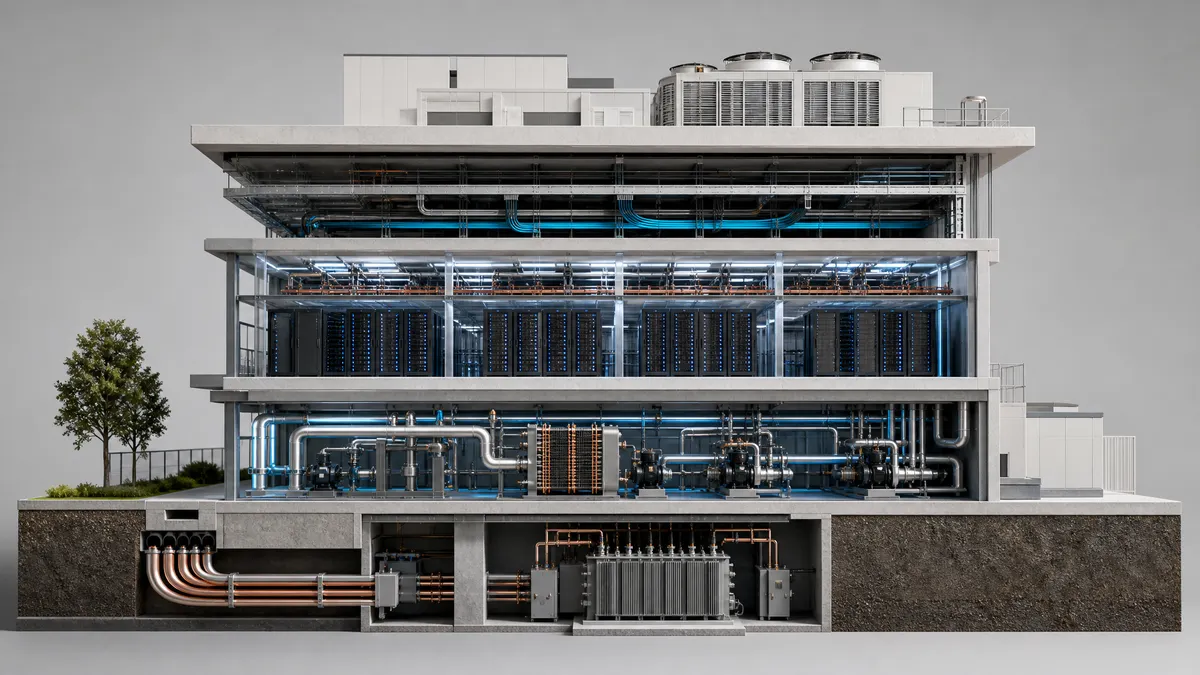
At frontier scale, that is the wrong picture. The model on the screen is only the visible surface. Underneath it sits a physical stack: chips, high-bandwidth memory, advanced packaging, servers, networks, data centers, power contracts, cooling systems, cloud platforms, capital, talent and geopolitical access.
That stack decides who can train advanced models, who can deploy them cheaply, who gets access, who pays more, and which countries can build without asking someone else for capacity.
This is why AI is becoming infrastructure. The Signal explains why the frontier conversation changed. The Stack explains the machine that gives that conversation weight.
Not because AI stopped being software. Because software at this scale now depends on industrial systems that cannot be downloaded, copied or shipped overnight.
The model is not the machine
The easy version of the AI story starts with the model.
A new system appears. It writes better code. It reasons through harder tasks. It sees images, hears audio, uses tools, searches documents and generates plans. The interface feels weightless, so the technology feels weightless too.
But a frontier model is not a floating intelligence. It is the output of a machine.
Training it requires dense clusters of specialized chips. Running it for millions of users requires inference capacity. Keeping it fast requires memory, networking and software orchestration. Keeping it online requires buildings, electricity, cooling, fiber, backup systems and people who can operate the whole system.
A model can impress the public in a demo. It cannot become infrastructure unless the stack underneath can scale.
That is the part most casual AI coverage misses. The race is not only for better algorithms. It is also a race to build the physical and financial system those algorithms require.
Intelligence now has a supply chain
The AI stack begins before a model is trained.
It begins with chip design, semiconductor manufacturing, high-bandwidth memory, advanced packaging and supply contracts. A powerful accelerator is not useful by itself. It needs memory close enough and fast enough to feed it. It needs packaging that can connect components at extreme density. It needs servers, racks, networking, storage and cooling.
Then comes the site.
The data center needs land, grid access, transformers, substations, switchgear, power-purchase agreements, fiber routes, water or other cooling strategies, construction labor, permits and long-term operating discipline.
Then comes the cloud layer.
Capacity has to be scheduled, priced, allocated and kept busy. Expensive chips sitting idle are not power. They are stranded capital. The software layer decides whether the physical stack becomes useful intelligence or an expensive heat source.
That makes frontier AI different from ordinary software.
A web app can often scale by renting more cloud capacity. Frontier AI depends on specialized capacity that may be scarce, pre-sold, geographically constrained or tied to a handful of infrastructure owners.
The word "compute" hides this whole chain.
The better word is stack.
Chips and memory decide who can train
The first visible bottleneck is the accelerator: GPUs and custom AI chips built for machine learning workloads.
But chips are not enough. High-bandwidth memory has become one of the quiet constraints in the AI buildout. If a chip cannot get data fast enough, raw processing power is wasted. Advanced packaging matters for the same reason. Modern AI hardware depends on tightly connecting compute and memory in ways that are hard to manufacture at scale.
This is why the AI supply chain is not just a Nvidia story, even when Nvidia dominates the public conversation. It is also a TSMC story, a SK Hynix story, a Samsung story, a packaging story, a networking story and a logistics story.
The consequence is simple: model ambition now depends on industrial capacity.
A lab may have brilliant researchers and a strong training recipe. If it cannot secure enough chips, memory, cluster time or cloud access, it cannot compete at the frontier on the same terms.
That does not mean every useful AI system needs the largest possible model. Smaller models, specialized models and efficient deployment matter. But at the frontier, the ability to train and serve powerful systems depends on scarce physical inputs.
Data centers and power decide who can scale
A chip that cannot be powered, cooled, connected or installed is not usable compute.
That is why data centers have moved from background infrastructure to the center of the AI story. The facility is where hardware, electricity, cooling, grid access and capital meet.
This changes the tempo. Software companies like to move at product speed. Power systems do not. Transformers take time. Substations take time. Transmission takes time. Permitting takes time. Grid interconnection queues take time. Cooling strategy and site selection take time.
The International Energy Agency estimates that data centers consumed roughly 415 terawatt-hours of electricity in 2024, about 1.5 percent of global electricity use. That number will not decide the future by itself, but it shows the scale of the physical footprint. AI demand is pushing data centers toward denser, more energy-hungry sites.
That creates a new constraint on intelligence.
If the next frontier model needs more training compute, the question is not only whether the lab has the money. It is whether the hardware exists, whether the data center can house it, whether the grid can feed it, and whether the economics make sense once the model is served to real users.
The AI race is therefore also a power race.
Not in the abstract political sense first. In the literal electrical sense.
Capital and cloud decide who gets access
Infrastructure concentrates power because it is expensive.
Training frontier models and serving them at scale requires capital expenditure that most companies cannot carry. That gives leverage to hyperscalers, chip suppliers, large labs, sovereign funds, governments and the few firms that can sign long-term infrastructure deals before capacity exists.
Cloud platforms sit at a crucial point in the stack. They can finance capacity, buy chips, build data centers, negotiate power, and rent access to companies that cannot build their own clusters. That makes them enablers, landlords and strategic gatekeepers at the same time.
For startups, compute pricing can decide what business models are possible. For enterprises, cloud access can decide which AI systems they can integrate. For governments, sovereign compute becomes a question of autonomy: can a country train, host or audit important systems without depending entirely on foreign infrastructure?
This is where AI starts looking less like an app market and more like an industrial platform.
The companies closest to the stack can shape who builds, who pays, who waits and who depends.
Geopolitics decides who can build freely
Once compute becomes strategic, governments enter the stack.
Export controls restrict access to advanced chips. Industrial policy tries to pull semiconductor manufacturing closer to home. Energy policy starts touching AI deployment. National-security agencies pay attention to model capabilities, lab security and foreign access. Safety institutes test frontier systems. Governments ask whether AI capacity should be treated like normal cloud infrastructure or national capability.
That does not mean every AI data center is a military asset. It means the most advanced layers of the stack are no longer treated as ordinary commercial plumbing.
The reason is straightforward. If advanced AI systems become useful in science, cyber operations, defense planning, economic analysis, software production and strategic decision-making, then access to the underlying compute becomes leverage.
The stack gives some actors speed and optionality. It gives others dependence.
That is why The Signal leads here. When frontier AI builders talk about intelligence as a historical shift, the next question is not only whether the models will get smarter. It is who controls the machine that lets them get smarter.
More compute is not the same as more wisdom
The stack matters. It is not magic.
More compute can produce stronger models, but it does not automatically produce useful systems, safe deployment or better decisions. A model can use enormous resources and still fail inside a hospital workflow, a legal process, a classroom, a newsroom or a government agency. A data center can hold expensive chips and still struggle with utilization. A company can buy capacity and still lack product judgment, distribution, data quality or institutional trust.
This matters because infrastructure narratives can become their own hype cycle.
A bigger cluster is not automatically a better future. It is a larger bet. Sometimes the bet produces capability. Sometimes it produces waste. Sometimes efficiency, model routing, specialized chips or smaller models change the economics faster than the largest builders expect.
The real question is not "how much compute exists?"
The real question is: who controls useful capacity, at what cost, under which constraints, and for which workflows?
What remains uncertain
The stack is real. Its path is not settled.
It is not clear which bottleneck dominates next. Today it may be GPUs or high-bandwidth memory. Tomorrow it may be packaging, transformers, grid connections, cooling, land, skilled labor, software utilization, financing costs or regulation.
It is not clear how much efficiency will offset demand. Better models may reduce the compute needed for a single task while making AI useful in many more places. That can lower unit cost and raise total demand at the same time.
It is not clear how concentrated the stack will become. One path leads to a few infrastructure owners with enormous leverage. Another path includes more efficient models, open-weight systems, regional clouds, sovereign compute and specialized hardware that spread capability more widely.
It is not clear how governments will treat frontier compute. Export controls, permitting rules, energy policy, safety requirements and national-security pressure can all redirect the buildout.
The uncertainty is not whether infrastructure matters.
It is which layer becomes decisive next.
What to watch next
Watch high-bandwidth memory. If memory supply tightens, raw chip demand tells only part of the story.
Watch grid interconnection. An announced data center is not usable AI capacity until it has power, equipment and permission to connect.
Watch inference costs. Training gets attention, but serving models to millions of users decides whether AI becomes an everyday layer.
Watch cloud concentration. If a few platforms control most frontier capacity, application companies may build on rented intelligence they do not control.
Watch sovereign compute. Countries that cannot access advanced chips, cloud capacity or local data-center infrastructure may become customers rather than builders.
Watch efficiency. The most important infrastructure breakthrough may not be a bigger cluster. It may be a way to get more useful work from the same stack.
Read deeper
Start with Vastkind's deeper explainer: What Is Compute Infrastructure? Why Chips, Memory, Data Centers, and Power Now Shape AI.
Then follow the bottlenecks: AI's Grid Bottleneck Is Transformers, High Bandwidth Memory: Why HBM Is Deciding the AI Supply War, and AI Data Center Power: Why Fusion, Geothermal, and SMRs Are Entering the AI Race.
The Stack explains the machine underneath frontier AI.
The next guide asks what happens when that machine enters work, education, science, media, defense, governance and human judgment.
Next in the START HERE series: The Stakes.